
Policies, practices and attitudes promote universal ignorance
By Cliff Dickinson
Is it possible that 99 percent of the crane operators in the U.S. do not know at any given moment how much the crane they are operating is able to lift? Experts in the industry have reported as much. Week after week, I find operators in my classes who have been running cranes for years that do not have a clue to what a load chart means. Load chart illiteracy is universal. Of course, different levels of expertise exist but the range is from “not even knowing what a load chart is” to “having a basic, general understanding.” Rare is the operator who understands his chart fully.
The problem has four basic causes:
- The OSHA and ANSI standards do not provide for a standard format of load chart design.
- The crane manufacturers use load charts as a marketing tool.
- The employers do not provide the time or the training required for operators to learn the charts.
- The crane operator often does not believe that it is important to understand the load charts.
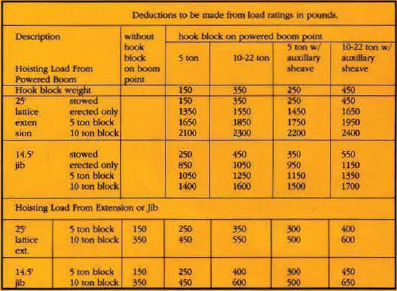
No standard format. Currently under ANSI standards each crane manufacturer can set up load chart deductions in any way he chooses. Three examples of load chart deductions show variance that occurs (See figures 1-3). The crane operator, who generally has to run more than one of these cranes, must fully understand and correctly determine the proper deductions for each one. Add to that the fact that load charts are written by engineers and lawyers and it’s not difficult to see why operators get confused. The crane operator’s primary skill should be handling the machine, not figuring intricate mathematical equations or deciphering legal documents.
Crane manufacturers should agree to one method of laying out a load chart and ANSI should take the lead in promoting this simple concept.
Marketing Tool To the manufacturer the load chart is a form of advertisement. The crane sales person has an advantage over the competition if he can show the potential customer that his 50 ton crane has greater capacities at longer radii, longer boom lengths and lower boom angles (which is the “real world” area of the chart) than his competitor’s 50 ton crane. To show a crane at its competitive best the manufacturer configures a chart reflecting the highest possible capacities. All of these ratings reflect static, ideal conditions. They are not the conditions under which the crane is used. Dynamic forces on the load such as a swinging load, shock and wind are not included. When these factors are calculated, capacities are much lower. The crane buyer usually compares picking ability by looking at the gross capacities of the crane at various coordinates on the chart. But operators need to know how much the dynamic forces reduce the actual picking ability of the crane in the field.
Deductions for load handling devices and crane attachments can vary considerably from one manufacturer to another. Some manufacturers use the actual weight of the load handling equipment while others use the effective weight. Keeping the two methods straight may not seem too difficult until you consider that the average crane operator may run two or three different machines in any given day.
Inadequate training. Horror stories are all too common about people (I don’t call them crane operators) who have been handed the keys to a crane, told to take fifteen minutes to familiarize themselves with the controls, then bring the crane to the job site to unload a truck or do some other work. A person can’t even read the average load chart in fifteen minutes.
Often the crane operator is not given the time to read the chart on the job because the work must get done and the employer does not see the need. He may believe the crane operator already possesses the practical skills necessary to run a crane. Employers (and supervisors) are so focused on getting the job done that often they don’t consider the problems created by rushing. Supervisors often want the operator to try and see if he can lift a load. In other words, he wants him use the “feel in the seat of his pants” to determine the capacity of the crane. If the load is located at a coordinate where the crane’s capacity is based on structural competence, a fact that can only be determined by reading the load chart, then a structural failure is likely. There is no warning in the equipment prior to a structural failure. An operator can’t feel a structural failure coming. And the supervisor who is watching the outriggers to determine the crane’s capacity is looking in the wrong place.
Machismo. Some crane operators take pride in their ability to know the limits of the equipment by feel. They will try almost anything to see if the crane can handle the load, and handle it faster than any other operator on the the job. This macho attitude is often rewarded by the employer in steady work. Many operators are willing to operate a crane with which they are unfamiliar. If they read the chart at all, it was probably not understood Notes and warnings, because they are not understood are passed over as being unimportant. The capacity listings are the only ones given any importance and they are ignored if a lift needs to be made that exceeds the chart. They assume that the manufacturer has built in a large safety margin.
The safety record of the construction industry is poor. With insurance rates rising dramatically for both contractors and manufacturers, safety issues must be tackled. Load chart simplification and operator training can surely make a difference.
Cliff Dickinson is associate director of the Crane Institute, a crane safety training organization